Research papers, white papers and reports
Your research, explained on film.
Explain a Paper turns academic papers, white papers and technical, policy and impact reports into short, narrated, captioned explainer films, so the ideas reach people outside the field.
For universities, companies, think tanks, charities and public bodies: anyone with work that deserves a wider audience. The films stay on brand, and nothing goes out until you have approved the script.
- Two sign-offs, not sixAn agency explainer asks for your sign-off at five or six stages. Here you approve a script and accept the film, and we do the rest.
- Built, not generatedNo made-up facts: every word, number and chart on screen comes from the paper, not from a model's guess.
- You can edit every scriptYou have full control: edit the narration, and say what you want to see at each point in the film. Nothing is rendered until you approve it.
- Captioned and accessibleCaptions and a transcript with every film. Captions can be translated into any language, and multilingual voiceovers are on our roadmap.
Who it's for
Anyone who needs a paper or a report understood by people outside its field: the public, customers, investors, funders, policymakers or colleagues in another discipline.
-
Universities and research institutes
Research-communications teams and press offices keeping up with what their researchers publish, and researchers who want a film of their own paper.
-
Industry and technology
White papers, R&D and technical reports, explained for customers, investors and colleagues who are not specialists.
-
Think tanks, charities and public bodies
Policy briefs, evaluations and impact or sustainability reports, explained for the public, funders and decision-makers.
-
Consultancies and professional bodies
Reports, guidance and technical standards, explained for clients and members who need the substance without the full document.
Built, not generated
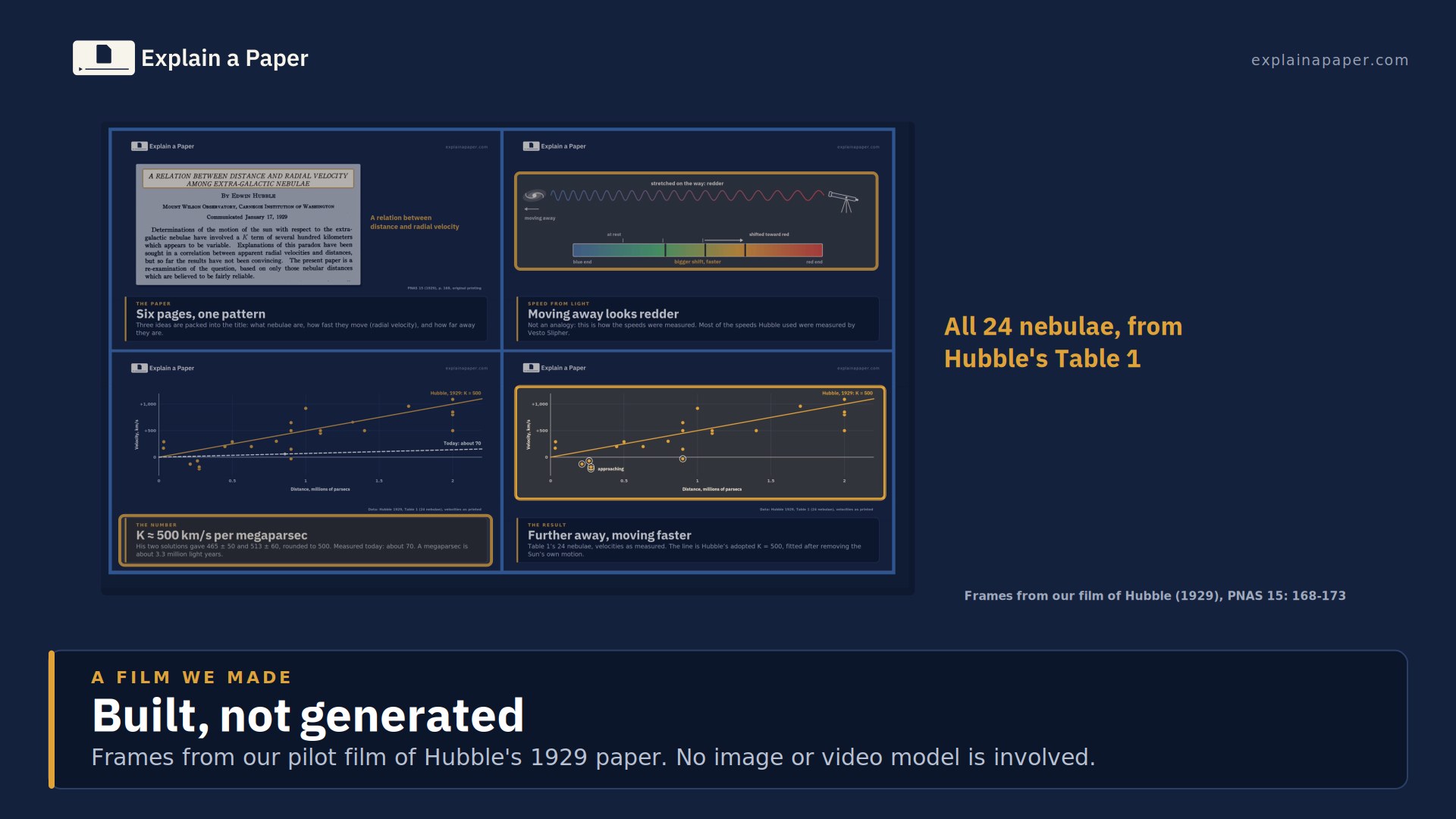
Generative video models paint every frame, so they can invent a number, a label or a result that sounds right but is not in the paper. We do not use them. Each frame is built from the paper's own words and data, so what the film shows can be checked against the source, line by line.

No made-up facts
Our software draws only what is in the script you approve, and the script is written from the paper, with the page, table or figure behind each line noted so you can check it against the source.
Typeset, not painted
Every word on screen is typeset, so there is no garbled lettering and no text that is not in the script you approved.
Plotted from the paper
Charts are plotted from the paper's own numbers. In our pilot film of Hubble's 1929 paper, all 24 nebulae come from his Table 1.
Drawn deliberately
Diagrams are drawn in code to show what the script says, not generated to look plausible. Labels stay legible and say what they are meant to.
AI-facilitated, not AI-generated
AI helps where it is useful. People decide what the film says.
You can edit every script
A language model helps draft a script from the paper, and one of our team prepares it. Then it is yours to edit. You have full control: change the narration, and say what you want to see at each point in the film. Nothing is rendered until you approve it, so what the film says is what you approved. For films that will be published widely, you can add human review: one of our editors, who did not prepare the script, checks it against the paper and signs it off.
An honest, synthetic voice
We use a synthetic narrator: an openly licensed voice model that runs on our own machines. How we use AI.
How it works
Four steps from a paper to a film you can publish.
Upload the paper
Send the PDF and tell us who the film is for: the public, customers, investors, policymakers or specialists in another field.
Read the script
We send you a draft script written for that audience. Add human review if you want an editor to check it against the paper first.
Edit it, then approve it
Edit the narration and say what you want to see, or ask us for changes. Nothing is rendered until you approve it.
Get your film
A narrated, captioned film with a transcript, ready for YouTube, LinkedIn and your website. 3 revision rounds are included; a round is one complete render of your film.
Drafting takes minutes, and once you approve the script your film is rendered in minutes, not weeks: about two and a half minutes for a 70-second film (measured September 2026). How long it takes.
Pricing
One film, a pack of credits to spend across several papers or reports, or a monthly plan for a team. Prices exclude VAT.
Single film
£39
£46.80 inc. VATOne film, with 3 revision rounds.
Full pack
£219
£262.80 inc. VATSix film credits to spend across several papers or reports, valid for 12 months.
Enterprise
from £499/month
from £598.80/month inc. VAT15 films a month in your own brand, for up to 5 colleagues. Human review is an option, not included.
Tell us what you would like explained
Upload a paper or report today and we will send you the draft script to review.