
For industry and organisations
Your white papers and reports, explained on video.
Explain a Paper turns white papers, technical and R&D reports, policy and sustainability reports and standards into short, narrated, captioned videos, so customers, investors, members and colleagues get the ideas without reading every page.
- Two sign-offs, not sixYou approve a script and accept the video, and we do the rest.
- In your own brandYour palette, typeface and logo on every video, imported free from your website or logo, or your own slide layout.
- Invoice and purchase order30-day terms, and a data processing agreement on request.
What organisations use it for
A document that took months to write deserves more readers than it usually gets. A short video is something people watch, share and come back to.
Sales enablement
Turn a white paper or a technical brief into a video your sales team can send before a meeting, so the buyer arrives knowing what the product does and why it matters.
Investor and stakeholder updates
Explain an R&D result, a technical milestone or a strategy paper to investors, boards and partners who need the substance, not the detail.
Explaining a technical standard
Help members, suppliers or regulators understand what a standard or a specification requires, what has changed and who it affects.
Internal knowledge sharing
Share a technical report or a research finding across teams and sites, with captions and a transcript so it works on an intranet with the sound off.
Sustainability and impact reports
Bring the key points of a sustainability, ESG or impact report to customers, employees and the public, alongside the full document.
Policy briefs and evaluations
For think tanks, charities and public bodies: a policy brief or an evaluation, explained for the public, funders and decision-makers.
Built, not generated
Technical and regulated content cannot afford a garbled number. Generative AI video models paint every frame, so they can invent a number, a label or a result that sounds right but is not in the document. We do not use them. Each frame is built from the document's own words and data, so what the video shows can be checked against the source, line by line.

No made-up facts
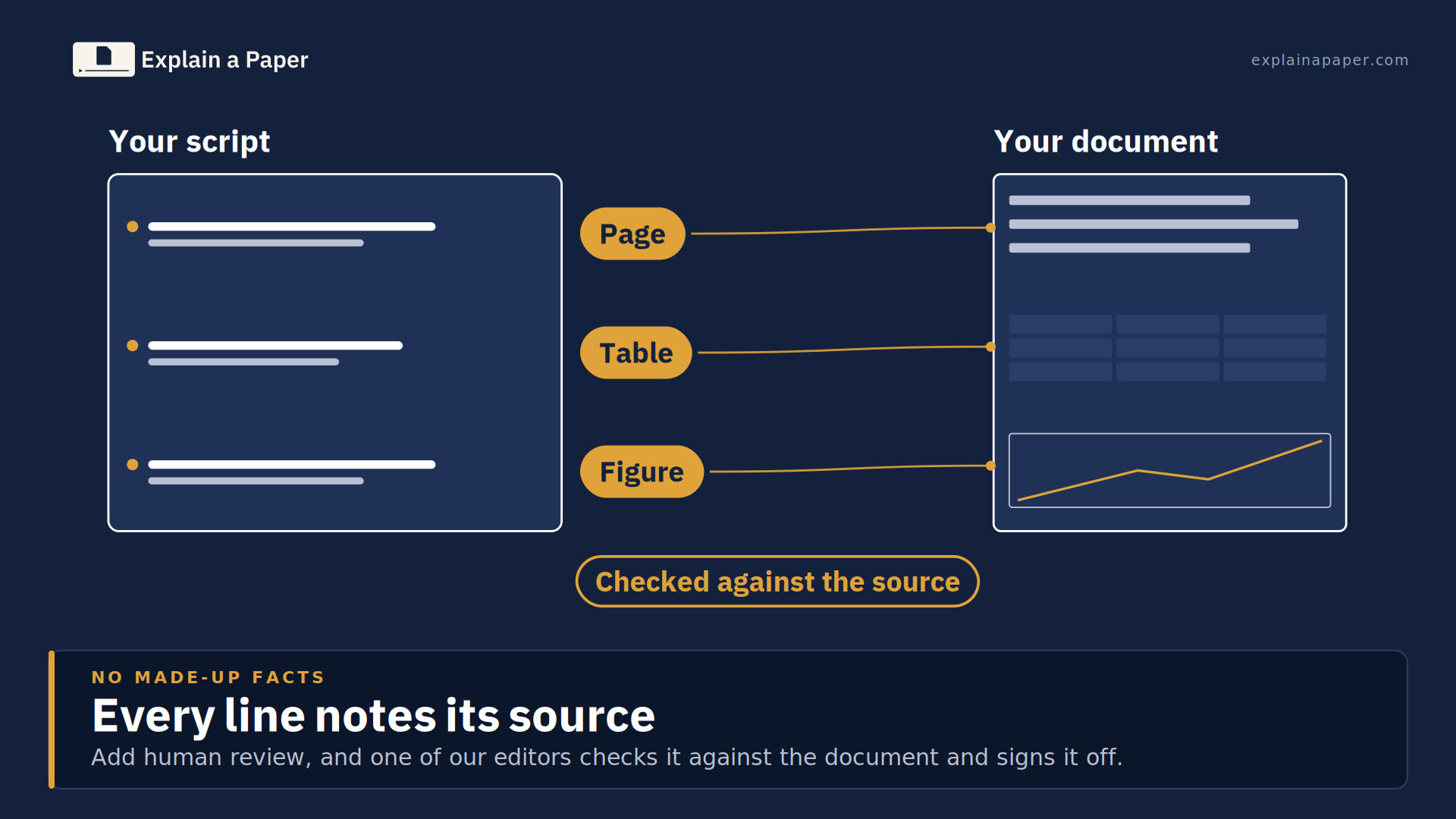
Our software draws only what is in the script you approve, and the script is written from your document, with the page, table or figure behind each line noted so your reviewers can check it against the source.
Typeset, not painted
Every word on screen is typeset, so there is no garbled lettering and no text that is not in the script you approved.
Plotted from your numbers
Charts are plotted from the document's own figures. In our pilot video of Hubble's 1929 paper, all 24 nebulae come from his Table 1.
Says what you approved
Diagrams are drawn deliberately, and what the video says is the script you approved, with human review by one of our editors if you add it.
Why AI video models get text, numbers and charts wrong, and how we keep videos true to the document.
Lighter on the planet, and on the budget
If your organisation is a B Corp, reports on its environmental impact or simply wants its communications to match its values, how a video is made matters as much as what it says.
- Against AI video generation. No AI video model paints our frames. In our September 2026 measurement, a whole 70-second video, the AI script drafting included, used about 50 to 90 watt-hours of electricity. One take of AI-generated footage for the same video, on the same machine, used 1.7 kilowatt-hours.
- Against traditional production. There is no crew, no travel, no studio and no location shoot: each video is written with you and drawn on one machine.
- Against a traditional animator (estimated). Estimated, from published studio guides: a one-minute 2D animated explainer takes 40 to 140 hours of skilled work, or 6 to 21 kWh on an office workstation. One of our 70-second videos takes up to two hours of our staff's time and an estimated 0.2 to 1 kWh in all, AI script drafting included: at least 6 times less electricity, at £39 a video before VAT. A model, not a measurement; travel, heating and your own time are left out on both sides (how we estimated it).
- Cheaper. Our single video is £39 before VAT. Wiley Editing Services publishes $525 for its one-minute Video Short (what each includes).
- Faster where it counts. The whole process, from paper upload to finished video, takes just a few minutes: no booking in, no briefing call, and no waiting the one to three weeks that published video abstracts quote for a first cut. Ready for a launch, or the day a report comes out.
For ethically minded organisations, that makes a constructed video a strong choice: far less electricity than AI video generation on our measurement, none of the travel and equipment of a traditional shoot, and a price of £39 a video before VAT.
What you send, and what you get back
You send
- A PDF of up to 25 MB that is not password-protected: a white paper, a report, a standard or a paper.
- Who the video is for, how long it should be and what to emphasise.
- Your choice of voice and layout, and your own brand, imported free from your website or logo.
- Confirmation that you may share it with us and, if the video is to show the document's own pages, that you have the right to have it adapted. For your own organisation's documents that is usually straightforward.
- A flag if it is confidential or under embargo (see below).
You get back
- A draft script, written for your audience, for you to edit: the narration, and what you want to see at each point. Nothing is rendered until you approve it.
- A narrated video with captions, a transcript and a poster image.
- 3 revision rounds with every video.
- The right to use, publish and share the video anywhere, permanently, including commercially. The script is yours.
Want a second pair of eyes? Add human review (£99 per video, £118.80 inc. VAT): one of our editors checks it against the document and signs it off before it comes to you. Your approval stays the final check.
More on how it works, and what to have ready before you order.
Confidential and embargoed documents
Much of what organisations want explained is not public yet. Here is exactly where we stand today.
Flag it, and it is treated differently
Mark a document confidential or under embargo, with the embargo date, when you order. Nothing from a flagged document is published or used as a sample, and everyone on our team who handles it sees the flag. You decide when to publish the finished video.
A confidential or embargoed document goes to a language model only under a zero-data-retention arrangement, or to a private model on infrastructure we control. Neither is in place yet, so we cannot yet process confidential or embargoed documents. You can prepare and save the order now, and we keep it and email you when we can. A zero-data-retention option is coming for confidential and embargoed papers.
Everything else
Our specialised AI agents draft each script. For a document that is not confidential or under embargo, this is what applies. Our language-model provider, Anthropic, may retain the material we send it for a limited period (currently up to 30 days, or up to 2 years if its automated systems flag the material as breaching its usage policy) for safety and abuse monitoring. It does not use it to train its models. You accept this when you submit the order.
If your organisation prefers, we can use your own Anthropic API key instead, in which case your organisation's agreement with Anthropic governs that processing.
Uploaded documents are stored privately, used only to make your video, and deleted 90 days after you accept the video.
Data protection
We process the personal data in your documents as your processor, and sign a UK GDPR Article 28 data processing agreement with your organisation on request. The privacy policy names everyone who processes your information.
Non-disclosure agreements
If you need a non-disclosure agreement in place before you share a document, say so in your enquiry and we will look at it with you before you send anything.
Your brand, your layout, your choice of voice
Your own brand
On every order, import your brand free from your website address or your logo, then check the colours, fonts and logo in a live preview. On the enterprise plan we also build a hand-made brand pack within 10 working days. Every video then carries your look. If your typeface cannot be licensed for video, we use IBM Plex Sans.
Upload your own layout
On any video, download our PowerPoint or PNG template, move the coloured boxes to where the title, text, animation and your logo should go, export the slide and upload it. Our team checks it before your video is made, at no extra charge.
Style and voice
Choose slides (text beside the animation), full animation or a mix of the two. Hear each synthetic narration voice before you choose; voices are always free, and every video says the voice is synthetic.
Enterprise
from £399/month
from £478.80/month inc. VAT- 15 video credits each month, for any document
- A brand pack built from your logo, colours and typeface
- Up to 5 members on one account, with one bill
- 3 revision rounds with every video
- Monthly; cancel at the end of any billing month
The monthly allowance does not roll over. Need fewer videos? A single video or a pack of credits works too.
Tell us what you would like explained
Tell us your organisation, the kind of documents you have in mind, roughly how many videos you expect a year, and whether you need a purchase order, an invoice or a non-disclosure agreement.
We reply to every enquiry, usually within two working days.
Send an enquiry
Email [email protected] with:
- your name and organisation
- the documents you have in mind, and videos per year, roughly
- whether you need a purchase order, an invoice or an NDA
Thank you. We have your enquiry and will reply, usually within two working days.
Universities and researchers
Explain a Paper started with university research. University comms teams and researchers have their own pages: for comms teams and for researchers.