
Darlings Lake from space: monitoring harmful algae blooms, explained
Evans et al. (2025), Frontiers in Remote Sensing, explained in plain language: how satellite images and a simple computer method tracked the blue-green algae blooms on Darlings Lake, New Brunswick, in 2021 and 2022, how closely they matched the lake's own buoys, and what the method cannot yet do. Every chart is plotted from the paper's own numbers, and no image from the paper is used.
Approved by co-author Stan Matwin
I watched both videos and really like them. They are very educational, and a great feature is how visual they are. [...] Great job. Keep going!
Transcript
Why did Darlings Lake, in Canada, turn green two summers running? Blue-green algae are really bacteria. Fed too much phosphorus from farms, towns and wastewater, they multiply. Harmful blooms can use up oxygen, make toxins that hurt wildlife, and harm people's health.
A Dalhousie University team and local groups asked: can satellites track these blooms? A buoy measures only where it floats. Satellites photograph the whole lake almost daily, in three-metre squares. Algae soak up red light but bounce back the shade just past red.
That gives each square a greenness score. But marsh plants are green all summer. So seven bloom-free days were averaged and taken away from each picture. A simple computer method then sorted the squares into six groups, like laundry by shade.
The strongest groups showed the bloom. The raw map lights up plants and bloom alike. Take away the baseline, and the plants fade. Checked by eye on three bloom days, the maps agreed well every time.
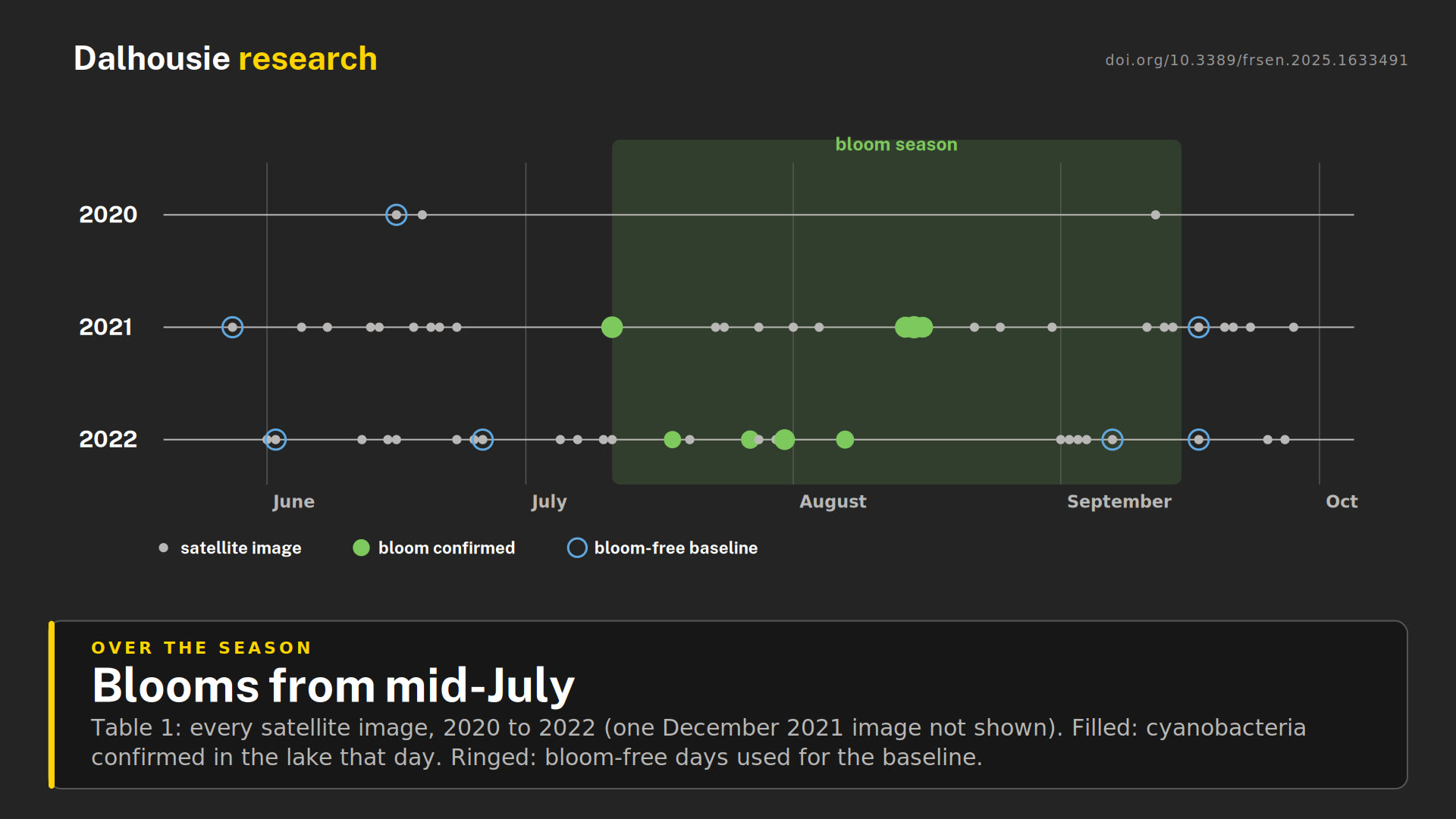
Two buoys measured a pigment the algae make. The score matched closely: zero point eight nine out of one. Another scored zero point one four. Blooms started in mid-July both years.
They spread across the lake in twenty twenty-one, but stayed near shore in twenty twenty-two. After a dry spring, July twenty twenty-one brought nearly three times its usual rain. That seems to have helped the blooms spread. This was a first test, on one lake.
Haze, smoke and wind can still fool it. By Catherine Evans and colleagues, in Frontiers in Remote Sensing, twenty twenty-five.
The paper
 Read the original paperEvans C, Gehrmann R, Greene C, Blenis S, MacKinnon R, Newport J, Vela S, Smith M, Sadeghi Z, Matwin S and Whidden C (2025). Monitoring harmful algae blooms in Darlings Lake, New Brunswick, using K-means clustering of multi-spectral imagery. Front. Remote Sens. 6:1633491. doi: 10.3389/frsen.2025.1633491On the publisher's site (doi.org/10.3389/frsen.2025.1633491)