
Hubble 1929, explained: the full-frame cut
The companion cut of Hubble 1929, explained: the same script and narration, with every scene drawn full-frame rather than beside a clip of the paper, so it reads well on a phone.
Plays from YouTube (youtube-nocookie.com) when you press play, so YouTube's privacy policy applies to the film. Watch on YouTube
Chapters
Transcript
PNAS, 1929
In nineteen twenty-nine, many astronomers pictured a universe that stood still. Then a six-page paper by Edwin Hubble found a pattern.
The paper
Its title: a relation between distance and radial velocity among extra-galactic nebulae. Three simple ideas hide in it.
Idea 1: nebulae
First, nebulae: faint, fuzzy patches in a telescope. Hubble had shown that some lie far beyond our Milky Way. They are galaxies.
Idea 2: speed
Second, speed. An ambulance siren racing away has its sound waves stretched, so its pitch drops. Light from a receding galaxy is stretched the same way, toward the red.
Speed from light
The dark lines in its spectrum shift, and the shift gives the speed. Third, distance.
Idea 3: distance
Identical lamps grow fainter further away. Know a star's true brightness, see how faint it looks, and you know how far.
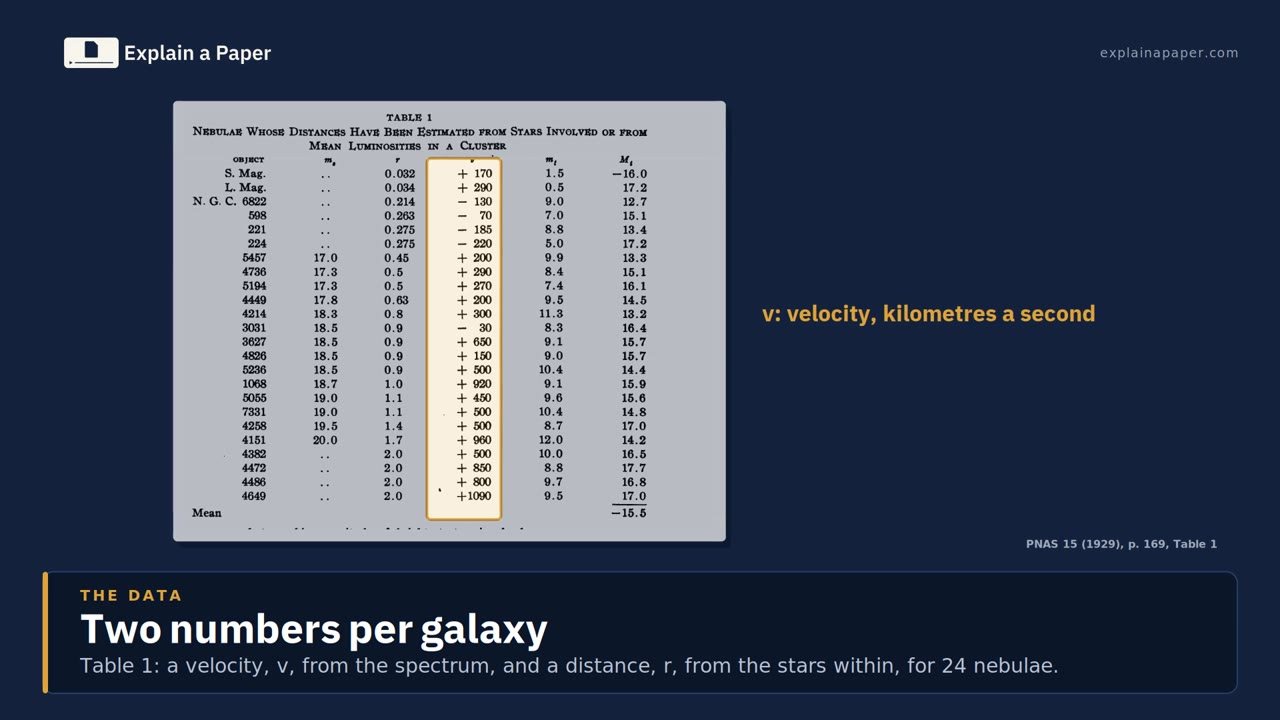
The data
His table puts the two together: for twenty-four galaxies, a speed from the spectrum and a distance from the faintness of their stars.
The result
Plot one against the other. A few near ones even approach. Beyond them, the further a galaxy, the faster it recedes, roughly in a straight line.
The number
The slope, which he called K, was about five hundred kilometres a second per million parsecs. Today's value is nearer seventy: his distances were too small.
What he claimed
Hubble was careful. He called it a first approximation, and thought it premature to discuss what it meant.
One reading
Others offered a meaning. Picture raisins in rising dough: as it swells, every raisin moves away from every other, and the furthest move fastest. Swap the raisins for galaxies, and you have an expanding universe: the reading that won out.
Explain a Paper
Every paper has a result worth seeing. Send us yours, and we will make its film. explainapaper.com
The paper
Hubble, E. (1929). A relation between distance and radial velocity among extra-galactic nebulae. Proceedings of the National Academy of Sciences 15(3): 168-173. doi:10.1073/pnas.15.3.168