
An ecosystem as a systems map, explained
A narrated SOSX video on what systems thinking is, told through a meadow whose rabbits boom and crash: the parts and links of a systems map, a reinforcing loop and two balancing loops, overshoot through a delay, the boom and crash as emergent properties, and a leverage point tested as a what-if. The meadow and its curves are illustrations with no real data.
Transcript
A meadow fills with rabbits, and then, almost as fast, it nearly empties. The rabbits multiplied, the grass ran short, and their numbers crashed before slowly recovering. A boom and crash like this is produced by how the meadow's parts are connected, so systems thinking looks there first. Study each part on its own, the rabbits, the grass and the foxes, and the crash stays a mystery, because the answer lives in the connections between them.
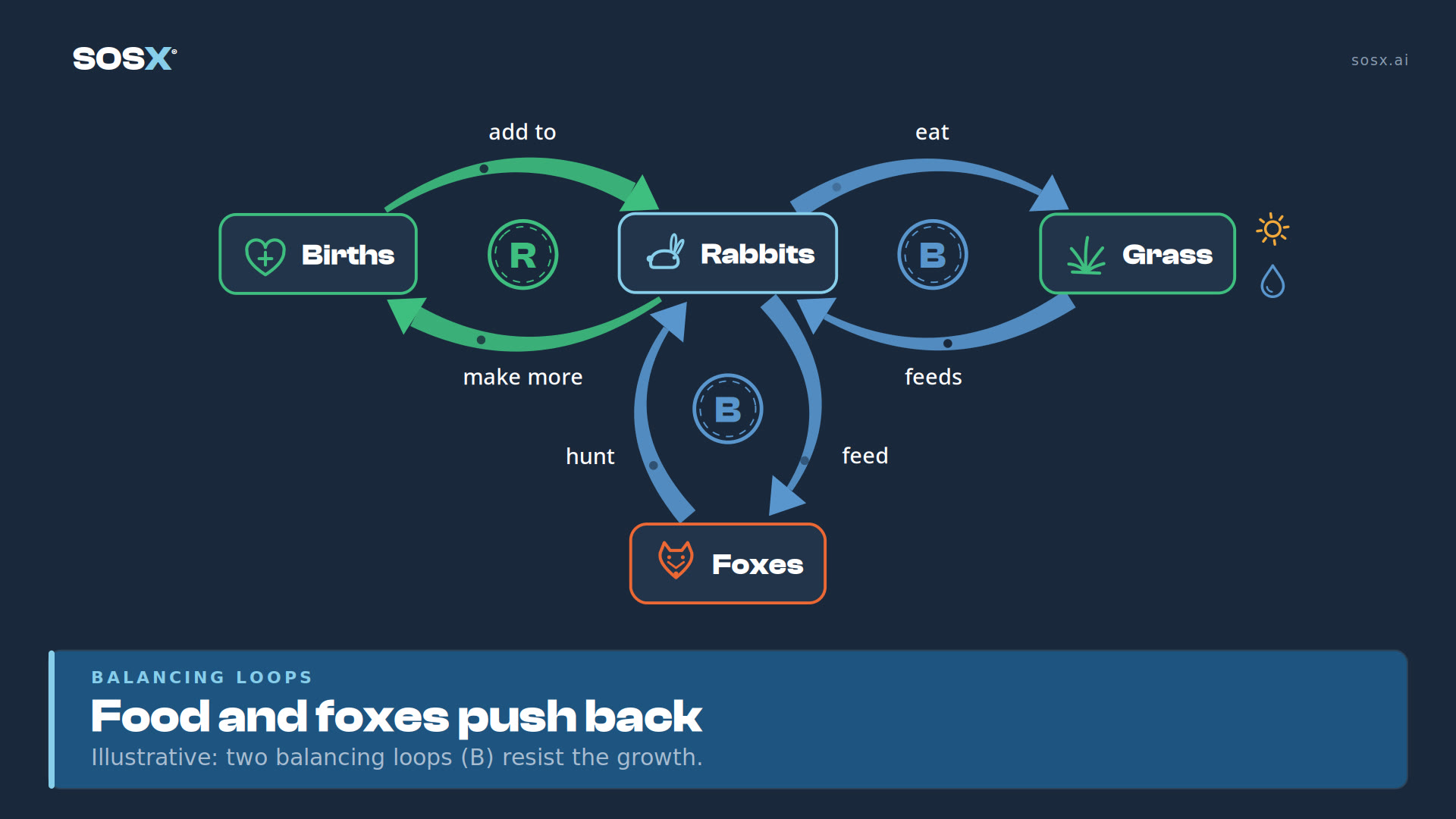
Systems thinking maps the whole system: the animals, their food, and the links between them, each saying what it carries. Births add to the rabbits, rabbits eat the grass, and foxes hunt the rabbits. Births and rabbits form a loop. More rabbits make more births, which make more rabbits.
A loop like this is called reinforcing, because it amplifies whatever is happening. Two balancing loops push back. More rabbits eat more grass, and less grass means fewer rabbits. More rabbits also feed more foxes, and more foxes mean fewer rabbits.
A balancing loop resists change, and sooner or later a growing loop meets one. The grass takes time to run out, so its push-back arrives late. By then the rabbits have grown past what the grass can feed, and with too little food left, their numbers crash. A delay inside a balancing loop is the most common way a system makes itself unstable.
No rabbit chose the boom, and no fox chose the crash. The boom and the crash come from the three loops working together, which makes them emergent properties: properties of the whole system that belong to none of its parts. A leverage point is a place to push on a system. Pushing the growth loop harder only brings the crash sooner, so the leverage is on what holds the growth back.
In an illustrative what-if, keeping enough foxes strengthens a balancing loop, and the meadow holds steady, with no boom and no crash. SOSX, an AI platform for systems thinking, does this mapping for you. You bring one broad question, and its specialised AI agents research it and map the whole system around it as one connected model. SOSX runs comparative and feasibility studies and what-if analyses on that model, with every claim citing its source.
When the world moves, you re-run the model rather than rebuild it. This video was made with Explain a Paper. Try it yourself: get started today at explainapaper.com.