
City traffic as a systems map, explained
A narrated SOSX video on what systems thinking is, told through a town whose roads are jammed: the parts and links of a systems map, a reinforcing loop and a balancing loop, gridlock as an emergent property, and a leverage point tested as a what-if. The traffic and the what-if are illustrations, not a study of any real town.
Transcript
Every road in town is jammed. The buses are stuck and the deliveries are late, yet no single car caused the jam. Take one question: how could the town cut its traffic? The question touches roads, buses, parking, schools, deliveries, workplaces, shops and air quality.
When each part is studied on its own, every piece can be done well and the answer is still missed, because the answer lives in the connections between the pieces, where nobody is looking. Systems thinking maps the whole system: the parts, the people, and the links between them. Each link says what it carries. Buses run on roads, commuters ride the buses to work, and parents drive to school.
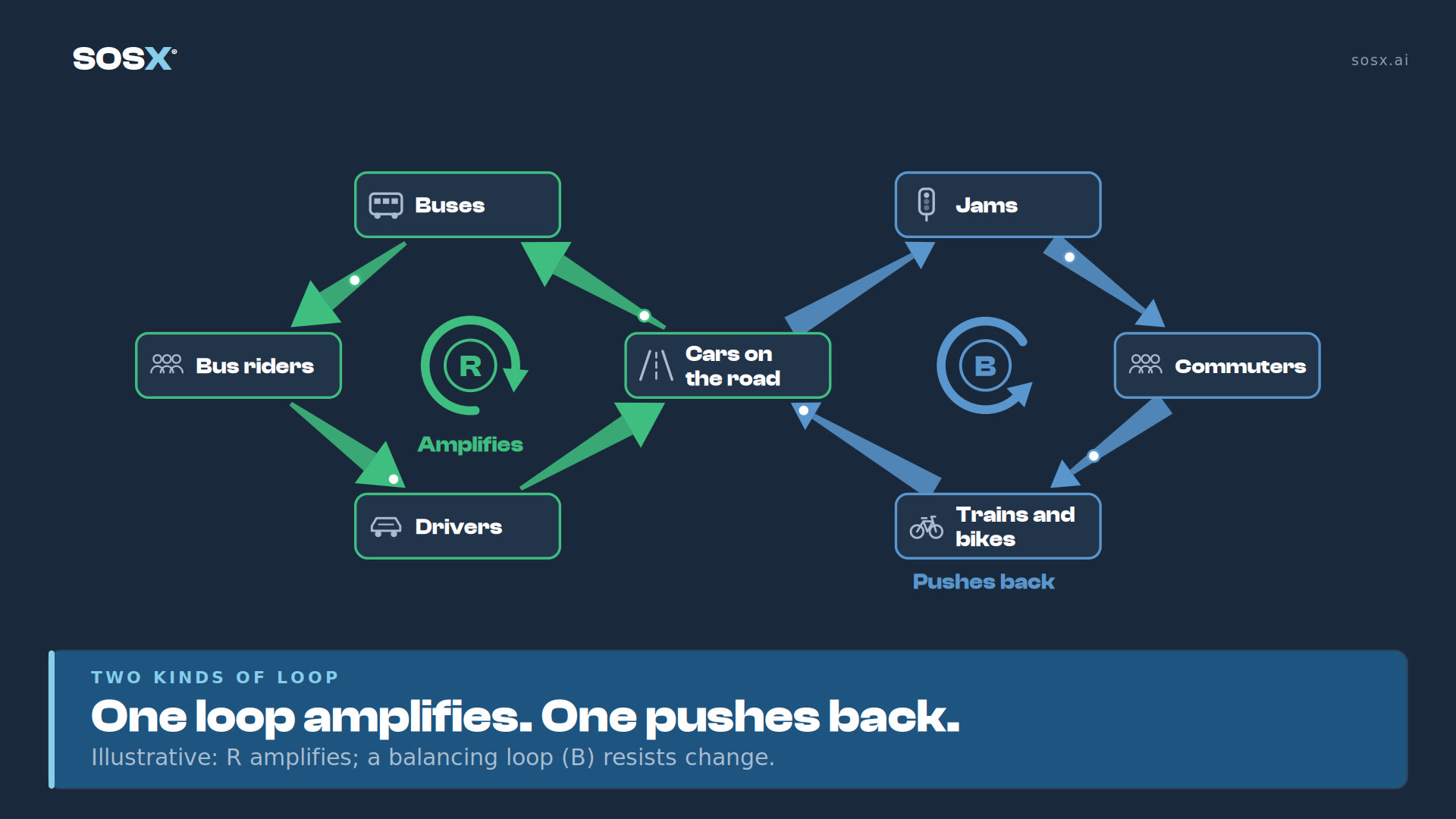
Some links join up into a loop, so a change comes back round to where it started. More cars slow the buses. Slower buses lose riders, and some of those riders take to driving, which puts more cars on the road. A loop like this is called reinforcing, because it amplifies whatever is happening.
Loops come in two kinds. Beside the reinforcing loop runs a balancing loop, which resists change. Jams put commuters off driving, so some switch to trains and bikes, which takes cars off the road and eases the jams. Balancing loops are why systems push back.
Gridlock comes from how the loops interact, not from any one driver. That makes gridlock an emergent property: a property of the whole system that belongs to none of its parts. A leverage point is a place to push on a system, and some push harder than others. Changing a feedback loop usually does more than changing a single number, because a system's structure absorbs a changed number and carries on.
In an illustrative what-if, a bus lane keeps the buses clear of the queues, which weakens the reinforcing loop, and in this example the traffic eases. SOSX, an AI platform for systems thinking, does this mapping for you. You bring one broad question, and its specialised AI agents map the system around it as one connected model. SOSX then runs trade-off and what-if analyses, and comparative and feasibility studies, with every claim citing its source.
When the world moves, you re-run the model rather than rebuild it. This video was made with Explain a Paper. Try it yourself: get started today at explainapaper.com.